People suck at predicting the future
Why prototype testing beats hypothetical feedback every time
8 December 2025
People suck at predicting the future
Why prototype testing beats hypothetical feedback every time
8 December 2025
Ask someone whether they'd use a feature you're working on and they'll say "yes", often with childlike enthusiasm. You build it, ship it and check back on the analytics, and you'll usually be met with confusion at the engagement and metrics before you. I wouldn't exactly say it's dishonesty, but rather just the brain doing what it does when asked to predict the future behaviour: getting it completely wrong.
So why does this happen?
- 1. Affective Forecasting: Daniel Gilbert spent years studying this concept, which is our ability to predict how we'll feel about something in the future. What he found was that we are abysmally inept at it. We overestimate how much we will want something, how intense (in emotional weight) it will be.
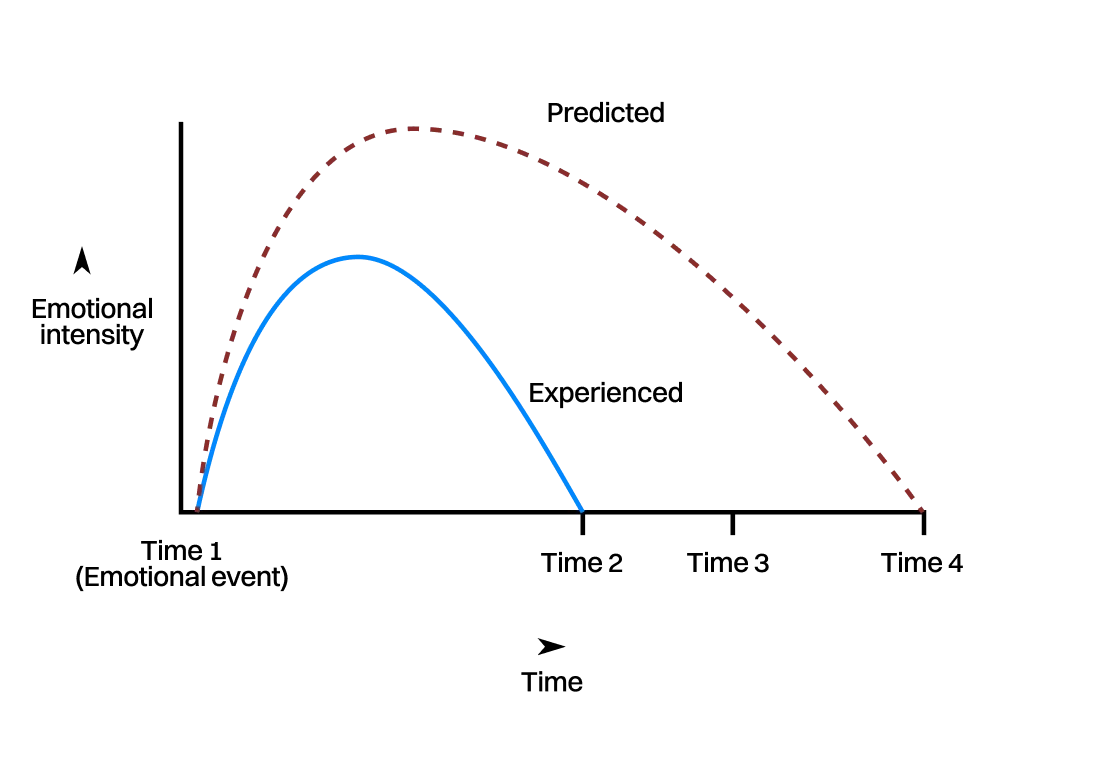
Fig. 1 — Predicted vs experienced emotional intensity over time. Adapted from Gilbert et al., "Immune Neglect," Journal of Personality and Social Psychology, 1998. - 2. Social Desirability Bias: This is when people sense they're being observed so they are thoughtful and polite and give answers they think is socially acceptable.
- 3. Stated v Revealed Preferences: Stated preferences are what users say they want when asked directly. Revealed preferences are what users actually choose through their behaviour in real context.
- 4. Hypothetical Bias: Ask someone if they'd pay $50 for your app and they'll say yes, absolutely, take my money. But put an actual checkout screen in front of them and suddenly they've got a 'thing' they need to go to and will get back to you. People are generous with imaginary money. Real money? Not so much.
Some hypotheticals to test
The 'Organic Juice Cart' is a perfect illustration of this. Survey a crowd: would you stop for a cold-pressed green juice on your commute? Most will probably say yes. The real cost of that question isn't at stake, nor do they have to weigh any options and consider tradeoffs. Then, put an actual cart on the pavement outside their office: most that said yes, walk right past it to the same coffee shop they always go. The hypothetical person and the real person with habits they've formed with a full inbox waiting for them are not the same person making the same choice.
This is why getting something in front of real users early is where the real data becomes available. A working prototype, even a rough 'duct-taped-together' one, forces people into actual decisions rather than imagined ones. The closer it is to the real experience, the more truthful feedback you receive. Let's be real, in most instances, faking the backend to get it into someones hands before you've sunk months on engineering and design validation is well worth it.
So how can we use this to get meaningful data for better user experience?
Observe behaviour: Rather than relying on opinions, watch where people hesitate, where they tap the wrong thing or where they seem frustrated as they restart the process. That friction is great data and being observant to small cues is an art form. A/B tests and dark launches work for the same reason because they capture actual choices. Analytics over surveys, every time you have the option.
Soft launches and phased rollouts apply the same logic to shipping a new product or feature. Release to a small slice of real users, see what happens, then decide. You get the truth without betting the whole product on it because people are unreliable narrators of their own future behaviour.