Product Design
Wireless Micro Camera Kit
Role
Lead Product Designer
Timeline
10 months
Platform
Hardware & iOS App
Methods
Interviews · Competitive Analysis · Usability Testing · Contextual Inquiry
Overview
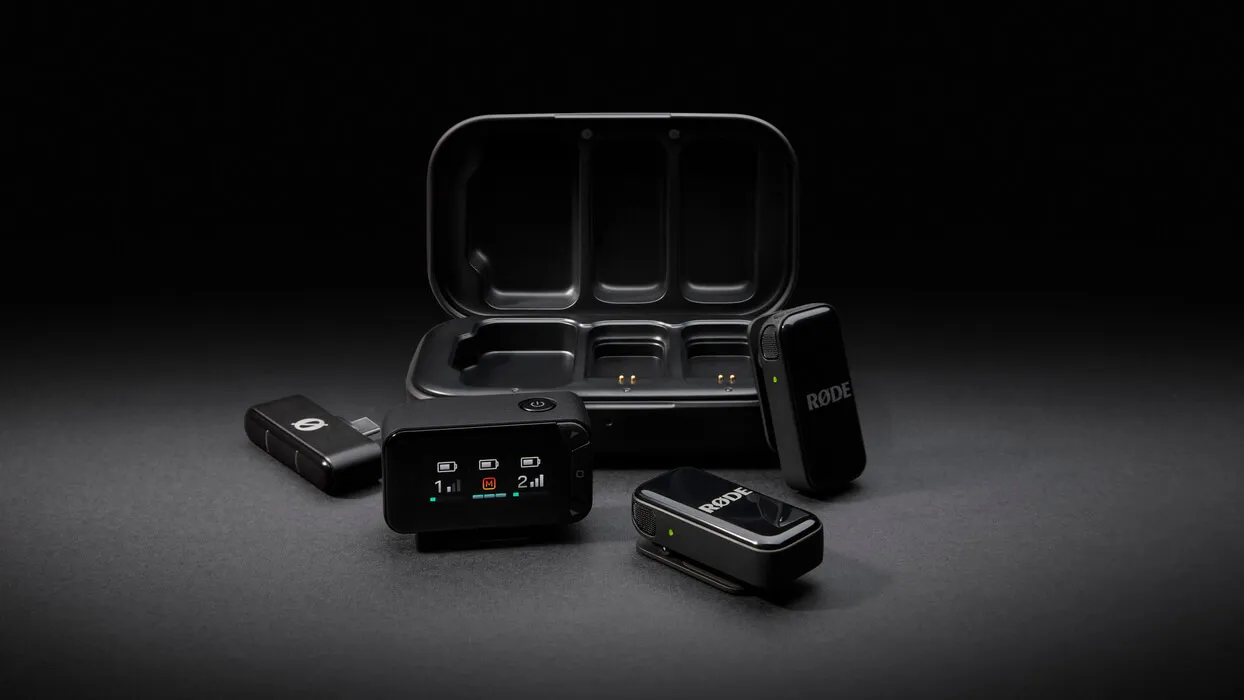
The Wireless Micro Camera Kit is RØDE's answer to a market crowded with compromises. Two ultra-compact transmitters with built-in microphones, an on-camera receiver with a 1.1-inch AMOLED screen, a USB-C smartphone receiver, and a charging case that delivers 21 hours of total runtime — all at a price point that removes the buying hesitation entirely.
The design goal was deceptively simple: make professional wireless audio something a creator grabs without thinking, uses without configuring, and forgets they're wearing. That required rethinking almost every assumption the category had inherited from professional broadcast gear.
The Market Before
Before this project, creators had three realistic options — and all three forced meaningful trade-offs. Understanding exactly where each competitor fell short shaped every decision we made.
RØDE Wireless GO II
Our own product — and it was losing
Excellent audio quality but critically missing camera-direct connectivity. No 3.5mm or USB-C output on the receiver meant creators needed an additional adapter cable. Phone connectivity was awkward. No charging case — batteries were a constant anxiety. DJI's Mic Mini was quietly eating into its market share by solving exactly these gaps.
DJI Mic 2
Strong UX, ecosystem lock-in
DJI had clearly done the user research. Auto-pairing, 32-bit float internal recording, and an intelligent form factor. But the receiver display faced directly upward — a fundamental ergonomic failure for vloggers and run-and-gun shooters who mount it on a camera. The DJI ecosystem also meant Android limitations and dependency on DJI's app infrastructure.
Hollyland Lark Max
Priced to win, built to disappoint
The Lark Max aggressively undercut on price and bundled accessories generously. But build quality reviews were inconsistent, the app experience was shallow, and the audio had an artificial low-end boost that sounded great in demos but fatiguing across a full day of footage.
RØDE Wireless PRO
Our pro answer — but the wrong audience
RØDE launched the Wireless PRO with 32-bit float recording — an industry first that generated genuine excitement among serious filmmakers. But that move was deliberately prosumer: at a higher price point, with onboard recording and advanced features, it served the documentary shooter, not the daily creator. The gap the Wireless GO II and Wireless Me had originally opened — casual, grab-and-go, universally compatible — remained wide open. The PRO proved we could out-engineer competitors on specs. The Micro Camera Kit had to prove we could out-think them on simplicity.
The Challenge
RØDE's own community was sounding the alarm. Creators on Reddit and in YouTube comments were praising competitors for solving what the Wireless GO II couldn't. The brief became clear: we weren't iterating a product — we were reclaiming a market.
"How might we design a wireless microphone system so frictionless that creators stop thinking about audio — and just create?"
The answer required solving three problems simultaneously: universal device compatibility, zero-configuration setup, and a price point low enough that the decision to buy required no deliberation.
Research & Discovery
We interviewed content creators across three segments — vloggers, journalists, and interview-format podcasters — to understand how audio gear fit (or failed to fit) into their actual workflows. We also conducted a systematic sweep of creator communities: Reddit's r/videography and r/podcasting, YouTube comment sections on competitor reviews, and RØDE's own support forums.
Five themes dominated the feedback regardless of which competitor product people owned. Setup time was a persistent frustration — creators described missing moments while pairing devices or adjusting gain. Audio levels between two speakers were almost always unbalanced, requiring post-processing. Battery anxiety shaped shooting decisions, with creators cutting sessions short rather than risking a dead mic. Most wireless systems forced a choice between camera or phone — not both. And the physical mounting experience ranged from awkward to genuinely embarrassing when shooting in public.
What Creators Were Actually Saying
Community feedback is product research. These weren't edge cases — they were patterns repeated across thousands of comments and threads that directly shaped our design decisions.
"I love the GO II audio quality but the fact I need a dongle just to use it with my iPhone kills me. DJI just works."
r/videography — on the Wireless GO II's phone connectivity gap
"DJI Mic 2 is great if you're all-in on the DJI ecosystem and on iPhone. Android support is second-class — half the features need the app, the app is flaky, and when it breaks you're flying blind on gain mid-shoot."
r/videography — on DJI Mic 2's app dependency and Android limitations
"Wireless mics shouldn't require a degree in audio engineering. I just want it to clip on and work."
YouTube comments on competitor review — on setup complexity
"The Lark sounds great in demos but after a day of real shooting the audio EQ gets tiring. They've boosted the bass to impress in a 30-second test, not a 3-hour shoot."
r/filmmakers — on Hollyland's tuned-to-demo audio character
Design Approach
The design strategy was built around a single conviction: every second a creator spends thinking about their microphone is a second they're not thinking about their content. We relentlessly interrogated every interaction — pairing, mounting, level management, battery — and asked whether we could eliminate the step entirely or make it invisible.
We made deliberate choices to not compete on features. The transmitter interface is minimal by design. Where competitors added EQ modes, recording formats, and settings menus, we asked what would happen if we made the right choice automatically. GainAssist is the most visible expression of this philosophy — it monitors both channels in real time and balances levels without the creator ever opening a settings panel.
Core Design Principles
Setup in Seconds
Remove the transmitters from the case and they're already paired. No menus, no codes, no waiting. The product should be ready before the moment passes.
The Product Disappears
Ultra-compact transmitters, magnetic mounts, and automatic level management mean creators forget the mic is there. The best tool is the one you stop noticing.
Universal by Default
Dual 3.5mm TRS and USB-C outputs, interchangeable receivers, and iOS Direct Connect — the kit works with whatever camera or phone the creator already owns.
Feature Prioritisation
We structured prioritisation using the Kano Model — a framework that maps features not by importance alone, but by how they shape user satisfaction relative to expectation. It forced a useful distinction: some things merely prevent dissatisfaction, while others create genuine delight. The instinct in hardware is always to add. Kano gave us language to cut with precision.
The Wireless PRO had already raised expectations for pro users with 32-bit float — but the everyday creator had a completely different Kano curve. Solving for the wrong audience's "delighters" would have increased cost and complexity without moving satisfaction for our actual target at all.
Basic Needs (Must-Be)
Absence destroys satisfaction. Presence is invisible.
Clean wireless audio, reliable connectivity, a physical output for both camera and phone. These features generated no praise — creators simply expect them. Failing here means failing entirely.
Performance Features (One-Dimensional)
More = proportionally more satisfaction.
Transmission range, battery life, display clarity, GainAssist responsiveness. Every incremental improvement here directly moved user confidence. We pushed these as far as the price point allowed.
Delighters (Attractive Quality)
Unexpected — disproportionate satisfaction gain.
Auto-pairing the moment transmitters leave the case. The charging case fitting in a jacket pocket. iOS Direct Connect with zero latency. These weren't features creators asked for — they were moments that made reviewers say "I didn't know a mic could work like this."
Deliberately Excluded
Indifferent or reverse for our audience.
32-bit float recording is a performance feature for documentary filmmakers — but indifferent for a daily vlogger who just wants levels that don't peak. Adding it would have raised price, added menu complexity, and solved an anxiety our target audience didn't have. GainAssist addressed the same fear at a fraction of the cost.
Key Design Decisions
AMOLED receiver with a forward-facing display
DJI's upward-facing display was the most consistently cited ergonomic failure in competitor reviews. Our receiver was designed to mount on the camera cold shoe and face directly toward the operator — the display readable at a glance while shooting. The AMOLED panel provides crisp visibility in all lighting conditions without draining battery.
Auto-pairing from the charging case
Pairing was the first interaction creators had with every wireless system — and universally the most frustrating. We engineered the transmitters to auto-pair the moment they're removed from the case. No button presses, no LED confirmation sequences, no app required. Pick them up and they work. This single decision changed how creators described the product: from "setup" to "just grab and go."
GainAssist — automatic level intelligence
Audio gain management was the skill gap that separated confident creators from anxious ones. One speaker louder than the other, a sudden shout, a quiet interviewee — these are solvable with post-production but stressful in the moment. GainAssist monitors both channels in real time and adjusts levels dynamically. The creator never touches a gain dial.
Dual outputs on a single receiver
The previous Wireless GO II forced a choice: camera or phone, never both in the same kit. The Camera Kit receiver includes both 3.5mm TRS and USB-C outputs, with a separate USB-C smartphone receiver included. A creator can switch between DSLR and iPhone mid-shoot without repacking or re-pairing.
Charging case as part of the product experience
Battery anxiety was a documented behaviour change — creators would cut shoots short rather than risk a dead mic. The charging case reframes the problem entirely. The transmitters charge inside it, it fits in a jacket pocket, and it holds enough charge for two full recharges. At 21 hours total runtime, battery stops being a variable.
Post-Launch Validation
The reception confirmed the decisions. Across independent reviews and community discussion, the language creators used aligned with the design intent — not features, but feeling.
"Lightning fast and the most intuitive pairing system I've used."
Man of Many review
"If you don't want to get bogged down with audio settings and just want to focus on creating content, these are an exceptional option."
CameraJabber review
"Easy as to integrate in your life."
Pickr review — 5/5
Learnings
Community feedback is product research
Reddit threads and YouTube comment sections told us exactly where competitors failed. The DJI display orientation complaint appeared hundreds of times — that's a specification, not an opinion.
Auto beats manual every time
GainAssist and auto-pairing were the two most praised features. Removing a decision is always more valuable than adding an option. Creators don't want more control — they want fewer things to control.
Ergonomics are features
A display that faces the operator, a clip that opens wide enough for real clothing, magnetic mounts that stick without ceremony — these aren't polish. They're the product. Physical interactions that feel awkward create doubt in everything else.
Price is a design decision
At $149, the Wireless Micro Camera Kit removed the considered purchase hesitation. Creators bought it the way they buy a memory card — practically without deliberating. That behaviour is a design outcome, engineered by the choices we made about what to cut.
Results & Impact
$149
Launch price — half the cost of Wireless GO II
21 hrs
Total runtime with charging case
100 m
Transmission range in open environments
The Wireless Micro Camera Kit landed as RØDE's most accessible professional audio product — and the most reviewed. Multiple outlets awarded it 5/5, with reviewers consistently anchoring praise on the things we designed to be invisible: the pairing, the levels, the battery, the mounting. The product was described not in terms of specifications, but in terms of confidence. Creators felt ready to shoot.